Homerun Brokers Buying Guide
· by Roger Widén · 23 min. read
Buying a luxury property in a foreign country is a monumental milestone. It represents not merely an investment of capital, time, and emotion, but a defining lifestyle decision. For decades, Marbella has stood as the crown jewel of the Mediterranean, captivating the world’s most discerning clientele with its effortless blend of glamour, privacy, and prestige. Yet, as we move through 2026, the mechanics of buying and acquiring a legacy estate on the Costa del Sol have evolved. The market is more sophisticated, the regulatory landscape more nuanced, and the digital tools at your disposal are more powerful and more essential than ever before.
As the Best Real Estate Agency in Europe for Spain (2025-2026), Homerun Brokers does not just facilitate transactions; we curate and orchestrate seamless acquisitions with precision and discretion. We understand that our clients demand absolute clarity, uncompromising professionalism, and impeccable execution at every stage. You are not simply buying bricks and mortar; you are securing a lifestyle, a financial asset, and a sanctuary for your family and for generations to come.
This comprehensive guide is designed to illuminate and navigate the 2026 Spanish luxury property market. Whether you are seeking a frontline beach penthouse on the Golden Mile, a statement contemporary villa in Nueva Andalucía, or an off-market architectural masterpiece in La Zagaleta, this document will serve as your definitive roadmap. We will guide you through the precise legal framework, uncover the true cost structure, clarify the current residency landscape, and ensure that your journey – from initial viewing to final notarial signature – is executed with absolute confidence and precision.
- Table of contents
- 1. Phase One: Strategic Preparation and Assembling Your Team
- 2. Phase Two: Understanding the Financial Framework for 2026
- 4. Phase Four: The Anatomy of a Seamless Acquisition
- 7. The Homerun Brokers Approach
You don’t have to navigate this journey alone. Our personalised approach means your dedicated broker will be your trusted partner throughout the entire process—curating tailored property searches, arranging viewings, and managing all the legal and logistical details. We aim to make your home-buying experience seamless, stress-free, and enjoyable.
Let us guide you through every step, including understanding the buying process and navigating applicable taxes. Your dream home awaits—let us help you find it.
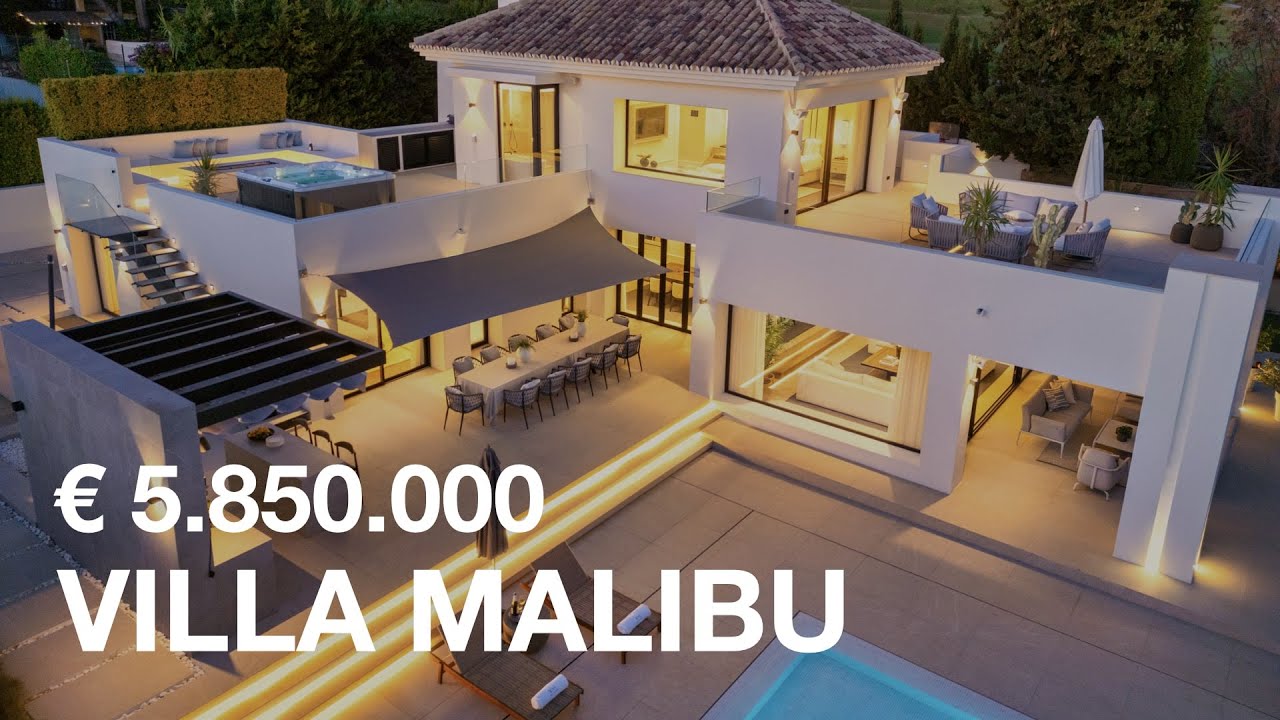
A contemporary Mediterranean masterpiece, Villa Malibu offers privacy, style, and exceptional amenities in the heart of Nueva Andalucía.
1. Phase One: Strategic Preparation and Assembling Your Team
The most successful real estate acquisitions are secured long before the first viewing takes place. Rushing into property viewings without a solid legal and financial foundation is a common misstep – one that can lead to missed opportunities, unnecessary exposure, or costly delays.
Defining Your Lifestyle and Investment Vision
Before engaging with the market, you must clearly define your parameters. Are you purchasing a primary residence for full-time relocation, a seasonal holiday home, or a high-yield rental investment? The answer will dictate the location, property type, and legal structure of your purchase. Before engaging with the market, you must clearly define your parameters. Clarity at this stage is not optional – it is strategic. Are you acquiring a primary residence for full-time relocation, a refined seasonal retreat, or a high-performing investment asset? The answer will dictate the location, property typology, and legal structure of your purchase.
If you are relocating with family, proximity to top-tier international schools such as Swans or Aloha College becomes a decisive factor. If you prioritise absolute discretion, gated hillside enclaves will naturally take precedence over vibrant coastal promenades. Establishing these non-negotiables early allows your advisory team to eliminate noise, streamline options, and present only the most relevant, high-calibre opportunities.
Assembling the "A-Team"
Acquiring property in Spain requires a carefully curated network of independent experts. Your real estate broker acts as your strategist and negotiator, but true success lies in the strength of the entire advisory ecosystem.
The Real Estate Broker: The Marbella market is uniquely complex. Unlike other jurisdictions, multiple agencies often list the same property, while access to truly exceptional estates is both limited and highly competitive. Understanding how to select the right real estate partner in Marbella is arguably the most critical decision in your acquisition journey. You require an agency with deep local intelligence, an impeccable reputation, and privileged access to off-market opportunities. At Homerun Brokers, we act as your single, trusted point of contact – discreetly navigating the entire market on your behalf, eliminating duplication, and unlocking doors that remain closed to the public domain.

The Independent Lawyer (Abogado): In Spain, the Notary does not conduct comprehensive legal due diligence; their role is purely to witness and certify the transaction. For this reason, appointing a specialised, independent Spanish property lawyer is not advisable – it is essential. Your lawyer will ensure the property is free from hidden liabilities, fully compliant with urban planning regulations, and legally sound for transfer without risk. We strongly recommend engaging legal counsel before your property search begins, ensuring they are fully prepared to act decisively and without delay when the right opportunity arises.
The Tax Advisor (Asesor Fiscal): Spanish taxation is highly nuanced and region-specific. A specialist tax advisor will structure your acquisition in the most efficient manner, advising whether to purchase in your personal name, through a Spanish SL (Sociedad Limitada), or via a bespoke international holding structure aligned with your global wealth strategy and succession planning.
Securing the NIE and Establishing Financial Infrastructure
You cannot purchase property, acquire a vehicle, or even set up utilities in Spain without an NIE (Número de Identidad de Extranjero) –your essential identification number within the Spanish system. Your lawyer can obtain your NIE via Power of Attorney (Poder Notarial) while you remain in your home country, ensuring your time in Spain is reserved exclusively for high-value activities such as viewings and decision-making. Simultaneously, your legal or brokerage team will assist in opening a Spanish non-resident bank account. This is critical, as the final property payment is typically executed via a bank draft issued by a Spanish financial institution – ensuring both security and compliance at completion.
2. Phase Two: Understanding the Financial Framework for 2026
Financial clarity is the cornerstone of a decisive and confident acquisition. The advertised price of a villa is merely the headline figure – never the full story. A sophisticated buyer must also account for acquisition taxes, professional fees, and the strategic mechanics of financing.
The True Costs of Buying Property in Andalusia
Andalusia, the autonomous region encompassing Marbella, has strategically positioned itself as one of Europe’s most attractive investment destinations, implementing favourable tax policies to attract international capital. However, acquisition taxes remain a material component of your overall investment, and understanding them in advance is essential to avoiding unwelcome surprises.
In 2026, the Transfer Tax (Impuesto sobre Transmisiones Patrimoniales or ITP) in Andalusia is currently set at a highly competitive, flat rate of 7%. This applies to all Resale Properties, regardless of the purchase price – a rare advantage in the European luxury landscape.
For New Build Properties (Off-Plan or Newly Completed): If you are buying a brand-new property directly from a developer, you do not pay ITP. Instead, you pay VAT (IVA), which is currently 10% for residential properties. In addition to IVA, you will also pay Stamp Duty (Actos Jurídicos Documentados or AJD), which in Andalusia is set at 1.2%.
Notary, Registry, and Legal Fees: Regardless of the property type, you must budget for Notary fees, Land Registry fees, and your lawyer’s fees. As a general rule of thumb, these professional fees typically add approximately1% to 2.5% of the purchase price, depending on the complexity of the transaction and legal structure.
The 2026 Mortgage Market
If you choose to leverage your investment, the Spanish banking sector remains robust, liquid, and highly receptive to international buyers. Following the European Central Bank rate fluctuations of the mid-2020s, the mortgage market has elegantly stabilized in 2026, offering highly competitive rates and predictable lending conditions.
For Non-Residents: Spanish banks categorize buyers based on their fiscal residency. If you pay your income taxes outside of Spain, you are a non-resident. In 2026, banks will typically finance up to 60% or 70% of the property's valuation or purchase price (whichever is lower). Fixed interest rates for non-residents currently hover between 3.2% and 4.25%, depending on financial profile and the bank's requirements for tied products (like home insurance).

For Fiscal Residents: If you are officially a resident of Spain, you can access financing up to 80% (and occasionally more for primary residences), with highly attractive fixed rates often falling between 2.6% and 3.5%.
Before making an offer, we recommend consulting our comprehensive mortgage guide to understand the current banking criteria, required documentation, and approval timelines. Having an agreement in principle from a bank transforms you into a cash-equivalent buyer, strengthening your negotiating position immensely.
Valuations and Strategic Currency Management
When financing is involved, the bank will commission an official valuation. A formal property valuation in Spain provides an objective foundation for the bank's risk assessment. It is important to note that banks will lend based on the lower of the two figures: the valuation amount or the agreed purchase price.
For international buyers holding capital in USD, GBP, CHF, or other currencies, currency strategy becomes a powerful financial lever – not an afterthought. High-street banks often impose unfavourable exchange rates and hidden transfer costs. Instead, we strongly recommend working with a specialised FX broker, enabling:
• Access to institutional-grade exchange rates
• Forward contracts to lock in currency values
• Protection against volatility between deposit and completion
In many cases, strategic currency planning alone can yield savings equivalent to a significant percentage of your legal fees – an often overlooked advantage.
3. Phase Three: The Search Elevated by Technology and Precision
With your team in place, your NIE processing, and your finances structured, the search transforms from exploration into a highly targeted operation. The way high-net-worth individuals search for property in Marbella has undergone a revolution.
The Modern Viewing Experience
In 2026, the concept of spending a week being driven around to view dozens of unsuitable properties is entirely obsolete. Time is your most valuable asset – and we treat it accordingly. At Homerun Brokers, we conduct exhaustive pre-filtering. We view the properties on your behalf, providing you with unfiltered, honest feedback about the surrounding area, the quality of finishes, and any potential noise issues that glossy brochures conveniently omit. When you arrive in Marbella for physical viewings, your itinerary is highly curated – featuring only the most compelling opportunities aligned with your exact brief.
The Digital Evolution of Luxury Real Estate
The Marbella digital transformation has radically improved the acquisition process for our international clients. You no longer need to be physically present on the Costa del Sol to take the first critical steps. Through advanced luxury real estate technology, we provide:
- Off-plan visualisation tools allowing you to “stand” in a property before construction begins
- Immersive 4K virtual reality walkthroughs – true digital replicas, not generic video tours
- Drone-assisted perspectives showcasing views, orientation, and surroundings
For investors making swift decisions on highly competitive prime assets, this technology provides the confidence to place reservations from across the globe, knowing the property has been digitally and physically verified by their broker.

The Irreplaceable Value of Physical Inspections
While digital tools are powerful, they do not replace expert due diligence. Once you find a property that captivates you, and before you finalize substantial payments, we strongly advise a professional technical survey. Never underestimate the importance of property inspection when acquiring a legacy estate.
An independent architect or building surveyor will examine the property and assess
- Structural integrity
- Moisture and insulation
- Electrical and plumbing systems
- Roofing condition
- Performance of advanced features (home automation, pools, landscaping)
In the luxury segment, where properties often integrate complex engineering and bespoke design elements, ensuring flawless functionality is essential to protecting both your investment and your peace of mind.
4. Phase Four: The Anatomy of a Seamless Acquisition
You have identified the ideal property. Now begins the precise and highly structured legal process that transforms intent into ownership. The Spanish conveyancing system is robust and secure, provided you follow the precise steps under the guidance of your lawyer.
Step 1: Offer Strategy and Negotiation
Making an offer in the Marbella luxury market is a matter of strategy – not impulse. It is rarely defined solely by price. When you find the perfect estate, navigating the offer process buying property in Spain requires strategic finesse.
As your brokers, we analyse comparable recent sales, market exposure time (the time the property has been on the market), and the vendor's motivations. We then present your offer formally, strategically, with intent – in writing. A strong offer often includes proof of funds or an agreement in principle for a mortgage, demonstrating to the vendor that you are a serious, highly qualified buyer. We also negotiate what is included in the sale. A compelling offer typically includes
- Proof of funds or mortgage pre-approval
- Clearly defined timelines
- Well-negotiated inclusions (designer furniture, curated interiors, or bespoke elements)
The objective is not simply to secure the property – but to secure it on the most advantageous terms possible, with discretion and precision.
Step 2: The Reservation Agreement (Contrato de Reserva)
Once the price and terms are verbally agreed upon, the property must be formally secured and removed from the open market, eliminating the risk of competing offers. To achieve this, you will sign a Reservation Contract and pay a holding deposit.
- The Deposit: While 1% to 5% of the purchase price is the standard range in Spain, in the luxury segment it is typically between €10,000 and €50,000, or approximately 1% of the purchase price – sufficient to demonstrate serious intent while maintaining flexibility.
- The Terms: The agreement outlines the commercial framework of the transaction, including price, timelines, and key conditions.
- Protection: Crucially, this contract should state that the deposit is fully refundable if your lawyer discovers fundamental, unresolvable legal issues with the property during their due diligence.
The deposit is typically held in a secure client account,which may be managed by the real estate agency, the buyer’s lawyer, or the seller’s lawyer, depending on the transaction structure.
"Working with Homerun Brokers made the entire buying process feel effortless. Their team guided me through every step with clarity and confidence, making purchasing a home in Marbella not only smooth but genuinely enjoyable." – Buyer
Step 3: Legal Due Diligence – Precision Behind the Scenes
This is where your legal team delivers its greatest value: meticulous risk elimination.
While the property is reserved, your lawyers conduct an exhaustive investigation. They will request a Nota Simple from the Land Registry to confirm who exactly owns the property and whether there are any existing mortgages, embargos, or legal claims attached to it. Certain debts (such as mortgages or community fees) may be attached to the property and must be cleared prior to transfer.
Simultaneously, your legal experts will verify with the Town Hall (Ayuntamiento) records to ensure the property has the correct building licenses, a First Occupation License (Licencia de Primera Ocupación), and that there are no urban infractions. They will also confirm that the cadastral boundaries match the physical boundaries, and they will ensure that all community fees, IBI (local property tax), and utility bills are fully settled and paid up to date. This phase transforms uncertainty into certainty – ensuring the asset you acquire is as sound legally as it is architecturally.
Step 4: The Private Purchase Contract (Contrato Privado de Compraventa / Arras)
With legal clearance obtained, you proceed to the binding phase of the transaction. Your lawyer gives the green light, and you move to the Private Purchase Contract. This is the point of no return. It is a legally binding document detailing every aspect of the transaction.
At this stage, you will pay 10% of the purchase price (less the reservation deposit already advanced). Most commonly, this is signed as an Arras Penitenciales contract. Under Spanish law,
• If the buyer withdraws, the deposit is forfeited.
• If the vendor withdraws, they must return double the deposit.
This legal symmetry creates a balanced and secure framework for both parties.
If you are buying a new build or off-plan property, your payments must be guaranteed by a bank guarantee (Aval Bancario) or an insurance policy provided by the developer, protecting your funds in the highly unlikely event the development is not completed.
Step 5: Completion at the Notary (Escritura Pública de Compraventa)
The grand finale takes place at the office of a Spanish Public Notary. The Notary is a government-appointed official whose role is to ensure the transaction complies with Spanish law, to verify the identities of all parties, and to witness the signing of the title deeds. You are not required to attend in person. Many international clients opt for a Power of Attorney, allowing their lawyer to complete the transaction on their behalf with complete efficiency.
During this meeting:
- The Notary reads the deed aloud.
- The final balance of the purchase price is transferred to the vendor, usually via a bank draft.
- The vendor hands over the keys.
- The deed is signed by all parties – the buyer (or their lawyer), the vendor, and the Notary.
Ownership is effectively transferred upon signing before the Notary, but full legal protection against third parties is achieved once the deed is registered at the Land Registry.
5. Phase Five: Beyond Completion – Post-Purchase Logistics
The acquisition is complete, and the Champagne has been poured. But true service extends beyond the signature, andthe administrative work continues behind the scenes. Following the Notary appointment, your lawyer will handle several critical post-completion tasks.
Registration and Tax Finalisation
Your lawyer has 30 days to pay the applicable acquisition taxes (ITP or IVA/AJD) on your behalf within the statutory period. Once the taxes are paid, they will present the title deeds to the local Land Registry (Registro de la Propiedad) to have the property officially registered in your name. The full registration process takes anywhere from a few weeks to several months, depending on the local registry's workload, but your ownership is legally protected from the moment the Notary signs the deed.
Utility Connections and Financial Automation
Setting up utilities in a foreign country can be notoriously frustrating. Your legal team or our dedicated concierge service will ensure that the electricity, water, internet, and community fee accounts are transferred into your name. Furthermore, they will set up direct debits (domiciliaciones) from your Spanish bank account to ensure these bills, along with your annual local taxes (IBI and Basura/Rubbish collection), are paid automatically, preventing any disruptions.
Property Management and Staffing
A luxury estate requires ongoing maintenance. If this is a secondary residence, Homerun Brokers can connect you with elite property management firms who will handle security, pool maintenance, gardening, and housekeeping in your absence. If you are relocating full-time, we can assist in sourcing highly vetted domestic staff, private chefs, and security personnel – ensuring your residence is maintained to impeccable standards year-round.
6. The Golden Visa Termination. Navigating Residency in 2026.
For non-EU buyers (including British, American, and Middle Eastern clients), securing the right to live in Spain long-term has undergone a massive paradigm shift. While navigating residency, it is vital to understand the recent legislative changes surrounding the Spain Golden Visa. For years, the €500,000 real estate investment route was the default path to residency. However, in response to housing market pressures, the Spanish government initiated the termination of this specific property-based visa. In 2026, buying a luxury villa no longer automatically grants you a residency permit. Spain’s Golden Visa program was fully abolished in 2025, including all investment routes (real estate, financial investments, and business-related pathways). This road is closed, but Spain remains incredibly welcoming to high-net-worth individuals, entrepreneurs, and global professionals. The focus has simply shifted toward active contribution and remote work.
The Digital Nomad Visa: This is now the premier route for international professionals. If you work remotely for a company outside of Spain, or if you are a freelancer with predominantly international clients, the Digital Nomad Visa offers residency for up to three years (renewable). The Digital Nomad Visa may allow access to the Beckham Law regime, under which qualifying individuals are taxed at a flat 24% rate on Spanish employment income up to €600,000, while foreign-sourced income is generally not taxed in Spain
The Non-Lucrative Visa (NLV): For retirees or individuals who do not wish to work in Spain but have established passive income (from dividends, pensions, or global rental portfolios) and seek a refined lifestyle relocation. the NLV remains a powerful option. You need to demonstrate sufficient financial means to support yourself and your family without relying on the Spanish job market.
Business and Entrepreneur Visas: Designed for those investing in innovation, business creation, or significant financial participation in Spain’s economy. The original Golden Visa legislation still exists for significant capital investments but not in real estate (for example, starting a highly innovative business project in Spain that creates local employment or investing €1 million in Spanish companies or bank deposits).
With the right advisory structure, securing residency remains achievable and strategically advantageous. Our legal partners specialize in global mobility and will analyse your specific financial and professional profile to secure the most advantageous residency permit for your family, ensuring your relocation to Marbella is smooth and legally sound.

7. The Homerun Brokers Approach
Buying property in Marbella is not a transaction; it is an entry into one of the most exclusive and rewarding lifestyles on the planet. The process, while complex, is entirely manageable when you are supported by the right people.
At Homerun Brokers, our award-winning ethos is built on transparency, market mastery, and unwavering client advocacy. We guide our clients through each stage with measured expertise, ensuring every decision is informed, every risk addressed, and every opportunity fully realised. We do not disappear after the Notary appointment – we become your long-term partners on the Costa del Sol. We remain a consistent point of reference – whether you are refining your property, settling into the area, or planning your next strategic acquisition. You have reached a stage where precision matters more than persuasion. Marbella offers extraordinary opportunities … but only when approached with the right insight and guidance. We are here to assist – quietly, professionally, and with absolute attention to detail.
"As a foreign buyer, I expected complications, but Homerun Brokers handled everything seamlessly. From NIE guidance to mortgage advice and legal coordination, they ensured I always felt supported and well informed." – Foreign Buyer
8. Six Frequently Asked Questions (FAQs)
1. Q: Do I need to be in Spain physically to buy a property? No. Through the use of a Power of Attorney (Poder Notarial), your appointed Spanish lawyer can handle every single aspect of the acquisition on your behalf, including opening a bank account, applying for your NIE, signing the private contracts, and executing the final title deeds at the Notary.
2. Q: How long does the entire buying process take in 2026? If you are purchasing a resale property with cash, the process can be incredibly swift, often within 4 to 8 weeks from reservation to completion, depending on due diligence and legal checks. If you require a Spanish mortgage, the process typically takes 6 to 10 weeks (often stretching to 8–12 weeks for non-residents), as the bank requires time to conduct their valuations and risk assessments.
3. Q: Are there restrictions on non-residents buying property in Spain? Absolutely none. Spain encourages foreign investment. You have the exact same property rights as a Spanish citizen. The only requirement is securing your foreigner identification number (NIE) and ensuring your funds comply with international anti-money laundering (AML) regulations.
4. Q: What are the ongoing annual taxes I need to pay as an owner? You will be liable for IBI (Impuesto sobre Bienes Inmuebles), which is the local town hall property tax, billed annually. You will also pay a small rubbish collection fee (Basura). If you are a non-resident, you must pay a Non-Resident Imputed Income Tax (IRNR), which includes an imputed income tax based on the cadastral value if the property is not rented, and actual income tax on rental earnings if the property is let.
5. Q: What happens if the developer goes bankrupt when I am buying off plan? Spanish law provides stringent protections for off-plan buyers. By law, any stage payments you make to a developer must be secured by a Bank Guarantee (Aval Bancario) or a specialized insurance policy. In the event the developer fails to complete the project within the agreed timeframe, or goes bankrupt, this guarantee ensures your funds are returned to you in full. Your lawyer will meticulously verify that these guarantees are in place before you transfer any funds.
6. Q: Can I negotiate the asking price? Yes, negotiation is a standard part of the Marbella real estate culture. However, the margins depend entirely on the specific micro-market. In ultra-prime areas with low inventory, properties often sell at or very near the asking price. In other segments, there may be more flexibility. This is where the expertise of your broker is vital; we analyse the data to ensure your offer is aggressive yet highly credible.
